.png)


Business Setups Consultant in Saudi Arabia
RadiantBiz KSA supports company formation, MISA investment, banking preparation, and post-setup compliance. We help you understand the requirements before you commit to a structure, premises, or application
Your GPS for the business journey – RadiantBiz KSA Business Setup Consultants in Saudi Arabia
Why Set Up Your Business in the Kingdom of Saudi Arabia
Saudi Arabia is the largest economy in the Middle East and the only Arab member of the G20. That alone makes it hard to ignore. But what's changed in the last few years is how much easier it's become for foreign companies to actually get in.
Under Vision 2030, the Kingdom has rewritten its investment rules. Foreign investors can now hold 100% ownership in most commercial and industrial sectors without needing a local partner. The MISA investment license fee, previously SAR 2,000 ($530) to SAR 12,000 ($3,200) for the first year, has been suspended entirely as part of the government's push to attract foreign direct investment. That waiver has been in place for roughly two years and makes Saudi Arabia cheaper than several other GCC markets for initial licensing, though it's worth confirming the current status at invest.gov.sa before you file.
The numbers back up the momentum. More than 780 companies have been licensed under the Regional Headquarters (RHQ) program, well past the original target of 500 by 2030, and Riyadh's prime office occupancy hit 97% in Q2 2026. The industrial base has grown to over 13,660 establishments nationwide, up from 12,289 a year earlier
For foreign investors, the practical question isn't whether Saudi Arabia is worth entering. It's how to handle the regulatory steps without burning months on paperwork. That's where working with experienced business setup consultants in Saudi Arabia makes the difference
Tap into a $1.3 trillion economy, fueling growth and innovation.
Take the first step with,
RadiantBiz CEO Rizwan Ansari to ensure a seamless business setup and long-term success.

100%
4
2000+
7
Saudi Arabia Business Setup Consultancy Solutions
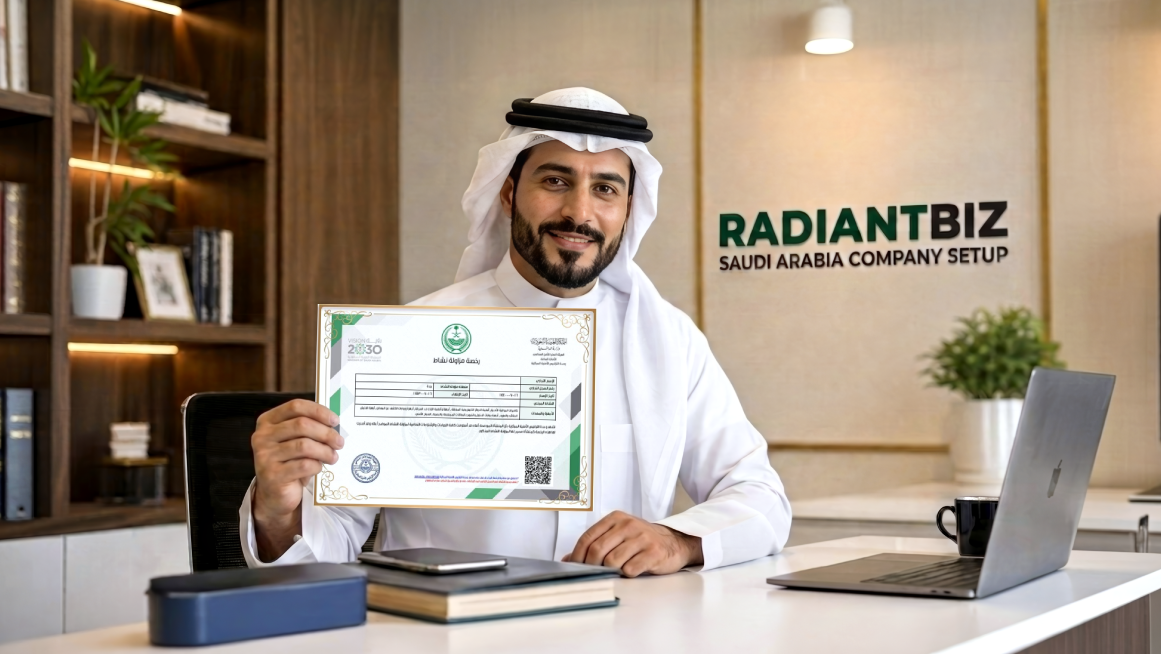
Business Setup Solutions
Your gateway to the Saudi market. We manage MISA licensing and commercial enrollment for a seamless, end-to-end legal setup in KSA.
.png)
KSA Tax & Zakat Advisory
Receive expert guidance on corporate tax, VAT, and Zakat compliance to ensure your business remains fully aligned with Saudi regulations.
.png)
Corporate Account Services
Assistance in selecting a suitable business bank account and streamlining financial operations efficiently.

PRO & Government Services
We handle all government interactions, including visas, work permits, and document processing, so you can focus on growing your business.

Regulatory & Compliance Services
Ensure your business activities meet the latest Saudi legal and regulatory frameworks, maintaining full compliance at all times.
Ready to Launch Your Business in Saudi Arabia?
Unlock the benefits of Vision 2030 with streamlined processes and 100% foreign ownership.
Your Roadmap to Setting Up a Business in Saudi Arabia

The setup can take as little as one week, depending on the business activity, ownership structure, and approval timelines.
Apply for the MISA investment license, draft and notarize the Articles of Association, and complete commercial enrollment.
Open a corporate bank account, obtain Chamber of Commerce membership, and complete required corporate credentials.
Apply for VAT and applicable taxes, apply for employee visas, and comply with Saudization (Nitaqat) requirements.
Types of Business Licenses in Saudi Arabia
Real Estate License
Service License
Entrepreneurial License
Trading (Commercial) License
Mining License
Industrial License
Professional License
Agricultural License
Why RadiantBiz KSA as Your Business Setup Consultants in Saudi Arabia
We've completed over 15,000 business setups for clients from 160+ countries. That experience isn't just a number, it means we've handled the edge cases, the sector-specific approvals, and the banking complications that trip up first-time entrants
What sets us apart:
RadiantBiz KSA was founded by Rizwan Ansari, who spent 16+ years in banking with leading UAE institutions before building the firm. That banking background translates directly into faster corporate account openings, the step that delays most Saudi setups by weeks.
We're rated 4.5 out of 5 on Trustpilot across 60+ verified reviews. Our work has been profiled in Gulf News, and we've received multiple awards from UAE government authorities for service excellence.
We don't just file your paperwork and disappear. Our team of Saudi Arabia business setup consultants handles the full lifecycle: pre-setup advisory, MISA licensing, CR issuance, banking, visa processing, Saudization planning, tax enrollment, and ongoing compliance. One team, one point of contact, from first call to fully operational.
Where to Set Up — Riyadh, Jeddah, or Dammam
The licensing process is national — MISA, the Ministry of Commerce, and the Companies Law apply everywhere.
But where you set up your office shapes what you'll pay for rent, who your customers are, and how fast you can hire. Here's how the three main cities break down.
Riyadh — Finance, Technology, and Government Contracts
Riyadh is where the decisions get made. Corporate headquarters, government ministries, sovereign wealth funds, and the Kingdom's largest commercial groups are all concentrated here. If your clients are Saudi corporates, government entities, or financial institutions, Riyadh is the obvious choice.
The King Abdullah Financial District (KAFD) has become the default address for finance and tech companies, and it's also the hub for the RHQ program. Office space is tight — Grade A occupancy has pushed past 97% — so expect higher rents and longer lead times to secure a suitable address.
Technology and healthcare companies drove more than half of all new office requirements in H1 2026. If you're entering fintech, healthtech, SaaS, or professional services, Riyadh puts you closest to the buyers.
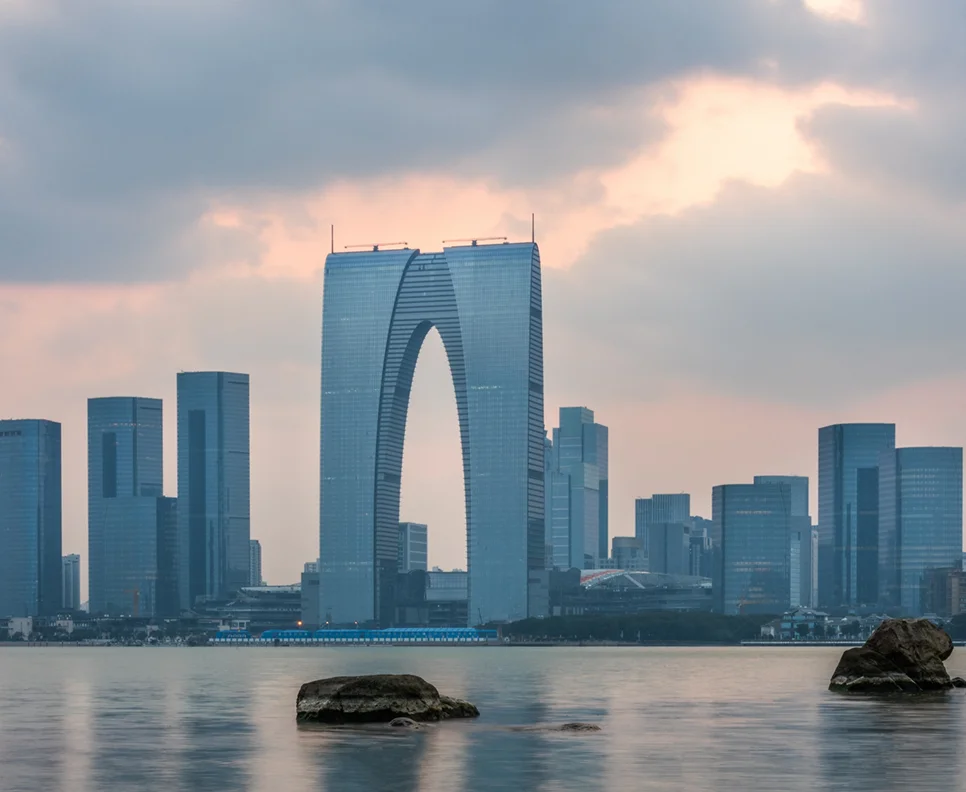
The kingdom's decision-making center
Riyadh is home to corporate headquarters, government ministries, and sovereign wealth funds, with KAFD as the default address for finance and tech
Jeddah — Trade, Logistics, and Consumer Markets
Jeddah sits on the Red Sea coast and has always been the Kingdom's commercial gateway. It's the entry point for imported goods, the base for trading companies, and increasingly a tourism and hospitality hub tied to the NEOM and Red Sea mega-projects.
Retail is expanding fast. New super-regional malls are opening through 2027, and prime retail vacancy is well below 10%. For consumer-facing businesses, food and beverage operators, and import/export trading companies, Jeddah offers both port access and a large, affluent consumer base.
Office rents are generally lower than in Riyadh, and the city's lifestyle and proximity to Makkah and Madinah add a draw for companies serving pilgrimage-related tourism and services.
.webp)
The kingdom's commercial gateway
Jeddah sits on the Red Sea coast as the entry point for trade and imports, with fast-growing retail and lower office rents than Riyadh
Dammam and the Eastern Province — Industry, Energy, and Manufacturing
Dammam and the wider Eastern Province are the Kingdom's industrial engine. This is where Saudi Aramco is headquartered, where the petrochemical clusters are concentrated, and where new manufacturing investment is landing. Energy Recovery, for example, recently announced its first factory outside the United States in Dammam's Second Industrial City.
If your business is in oil and gas services, industrial manufacturing, logistics, renewable energy, or mining, the Eastern Province puts you next to your supply chain and your clients. Office and industrial rents are the lowest of the three cities, and the Jubail and Ras Al-Khair industrial zones offer dedicated infrastructure for heavy industry.
Not sure which city fits? Book a free consultation with our business setup consultants, and we'll map your business activity to the right location, license type, and office setup.
The kingdom's industrial engine
Dammam and the Eastern Province host Saudi Aramco and major petrochemical clusters, with the lowest office and industrial rents of the three cities.
How Much Does it Cost to Set Up a Business in Saudi Arabia?
One of the most common questions we get, and one most Saudi Arabia business setup consultants avoid answering. Here's a realistic breakdown of what you should budget.
Total First-Year Budget
Most foreign company formations land between SAR 45,000 ($12,000) and SAR 150,000 ($40,000) all-in for the first year, depending on how many visas you need, whether you take a full office or a serviced address, and how many business activities are on your CR.
Startups using the Entrepreneur License pathway tend toward the lower end; companies opening a branch or subsidiary with multiple employees will be closer to the upper range.
These figures cover government fees and basic operational setup. They don't include Saudi Arabia business setup consultant fees, which vary by scope. We provide a transparent, itemized quote after understanding your specific business activity and structure, with no hidden charges.
Ready to Launch Your Business in Saudi Arabia?
Unlock the benefits of Vision 2030 with streamlined processes and 100% foreign ownership.
Frequently Asked Questions